

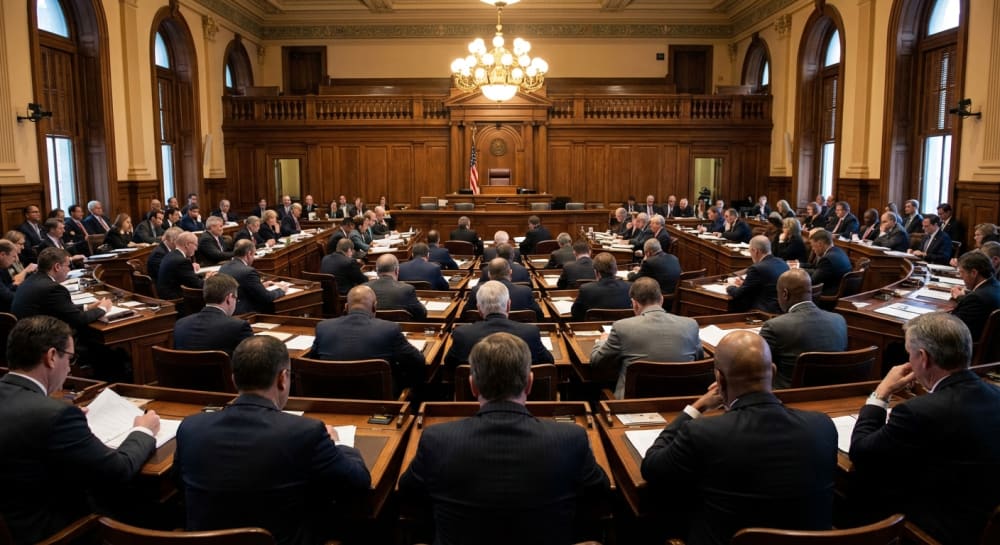
Vero Beach and Indian River County voters should prepare for notable changes to election procedures following a recent legislative push in Tallahassee. A new bill requiring voters to prove their United States citizenship at the ballot box has officially passed both legislative chambers and is now heading to the desk of Governor Ron DeSantis. The legislation, which promises to reshape voter identification standards, was heavily championed by local representation, with Senator Erin Grall of Vero Beach sponsoring the Senate version of the measure.
The legislation, officially known as HB 991, passed the Florida House of Representatives on a 77-28 party-line vote before clearing the Senate with a 27-12 vote. If signed into law by Governor DeSantis, the new mandates will not disrupt the immediate election cycle. Instead, the citizenship verification requirements are slated to take effect on January 1, 2027.
During the legislative debates, Vero Beach Republican Senator Erin Grall emphasized the need for proactive measures to maintain the integrity of Florida’s electoral process, stating the importance of addressing potential vulnerabilities before they can be exploited.
What is our tolerance for fraud and lack of integrity? And yes we have safe elections in Florida but they don’t stay safe and secure if we don’t pay attention to the large gaps that exist where we can address additional fraud.
The bill serves as Florida’s state-level counterpart to the federal Safeguard American Voter Eligibility, or SAVE America Act. However, unlike the proposed federal legislation, the Florida measure distinctly avoids placing new restrictions on mail-in ballots. This is a crucial detail for residents across the Treasure Coast and the state, considering that approximately three million of the 11 million ballots cast by Floridians during the 2024 general election were submitted by mail.
For Indian River County residents, the most immediate day-to-day impacts of the bill involve how identity is verified both at the polls and at local government offices:
- Driver’s License Updates: The Department of Highway Safety and Motor Vehicles will be required to explicitly note a person’s citizenship status on any new, replacement, or renewed Florida driver’s license.
- Changes to Accepted Voter Identification: Under the new rules, university and college student identification cards, as well as retirement home identification cards, will no longer be accepted as valid forms of identity verification at the ballot box.
Beyond the voter box, the bill introduces stringent new disclosure rules for political candidates. Individuals running for office will be required to formally disclose whether they hold dual citizenship with another country. Furthermore, candidates seeking federal office must declare whether they intend to trade stocks while serving. To bolster oversight, the state’s Office of Election Crimes and Security will be mandated to include any violations or irregularities related to foreign national involvement in state elections within its annual reports.
The legislation has generated significant debate. Democratic lawmakers, including Representative Anna Eskamani, voiced concerns that the dual-citizenship disclosure could encourage xenophobia, drawing comparisons to past political movements questioning candidate origins. Additionally, critics argue that invalidating student and retirement home IDs will disproportionately disenfranchise out-of-state students and elderly voters who may no longer drive or possess a valid license. The controversy is likely to continue into the legal arena, with Democratic elections lawyer Marc Elias publicly pledging to sue the state of Florida if the measure is enacted into law.