

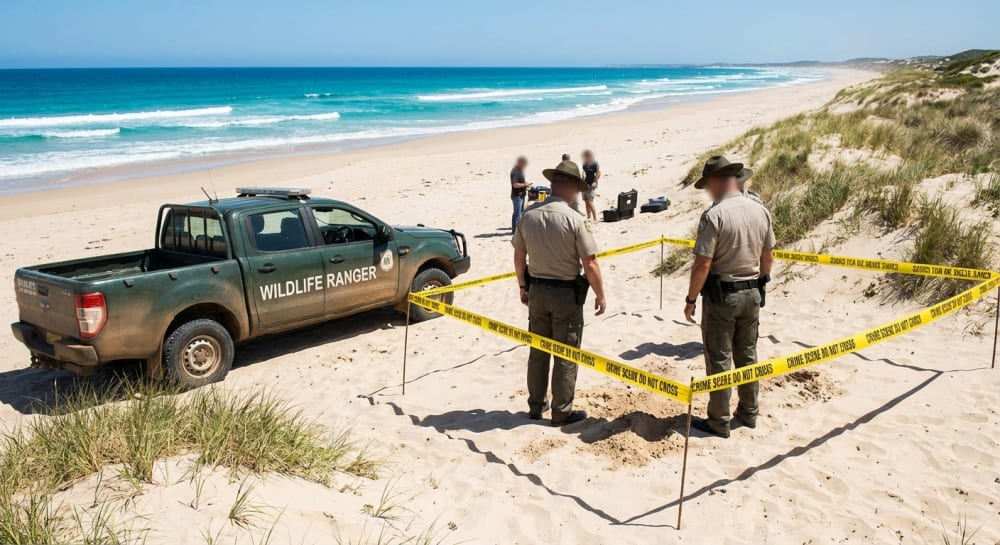
The Florida Fish and Wildlife Conservation Commission (FWC) has issued an urgent call for information, offering a $1,000 reward following the grim discovery of a mutilated great hammerhead shark just south of the Treasure Coast. Found washed ashore near the Juno Beach Pier on March 15, the critically endangered shark had its dorsal fin and tail sawed off, prompting an investigation that serves as a stark environmental reminder for all coastal Florida residents.
Anglers and beachgoers in Vero Beach and Indian River County share these same dynamic waters, making this incident highly relevant to our local marine ecosystem. Every spring, massive schools of migrating blacktip sharks hug Florida’s east coast, naturally drawing apex predators like the great hammerhead into our local shallows.
According to witnesses and conservation experts, the shark—an estimated 11 to 12-foot female—was likely caught by a shore-based fisherman rather than from a boat, as its body would have sunk to the ocean floor if caught offshore.
“Every hammerhead that dies, especially a female hammerhead is a problem, a big problem. … Whoever did this came prepared. It’s not easy to cut that dorsal fin off,” noted local resident Michael O’hagan, who documented the incident.
Experts from the non-profit organizations Fish Defender and Wildlife Voice suspect the shark likely died from the extreme physical stress of being caught on a fishing line before its fins were illegally harvested as trophies. Great hammerheads are exceptionally prone to capture stress. Unlike some shark species that can manually pump water over their gills, hammerheads must continuously swim to breathe. The intense struggle on a line causes fatal amounts of lactic acid to build up in their muscles, often leading to death even if they are eventually released.
Great hammerhead sharks are recognized as a critically endangered species by the International Union for Conservation of Nature and are strictly prohibited from harvest in Florida state waters. Additionally, removing a shark’s fins is a federal crime.
Local anglers in Vero Beach and the wider Treasure Coast must adhere to strict FWC regulations enacted to protect these vulnerable marine animals:
- Shore-based shark fishermen are required to obtain a free shark-fishing license and complete an online educational course.
- Chumming directly from the beach is strictly banned in state waters.
- Prohibited species, which include great hammerheads and tiger sharks, must be released without delay.
- If caught, prohibited sharks must remain entirely in the water with their gills submerged during the entire release process; dragging them onto the sand for photographs is a direct violation of state law.
While the gruesome nature of the finning has sparked outrage, local conservationists emphasize that the broader issue is the lethal impact of catch-and-release practices on this specific species. When heavy sharks are dragged onto the beach, the crush of gravity can cause internal organs to hemorrhage and capillaries to burst.
The FWC is actively seeking community assistance regarding this illegal mutilation. Anyone in the Treasure Coast or neighboring areas with information that could lead to an arrest is strongly urged to contact the Wildlife Alert Hotline at 888-404-3922.