

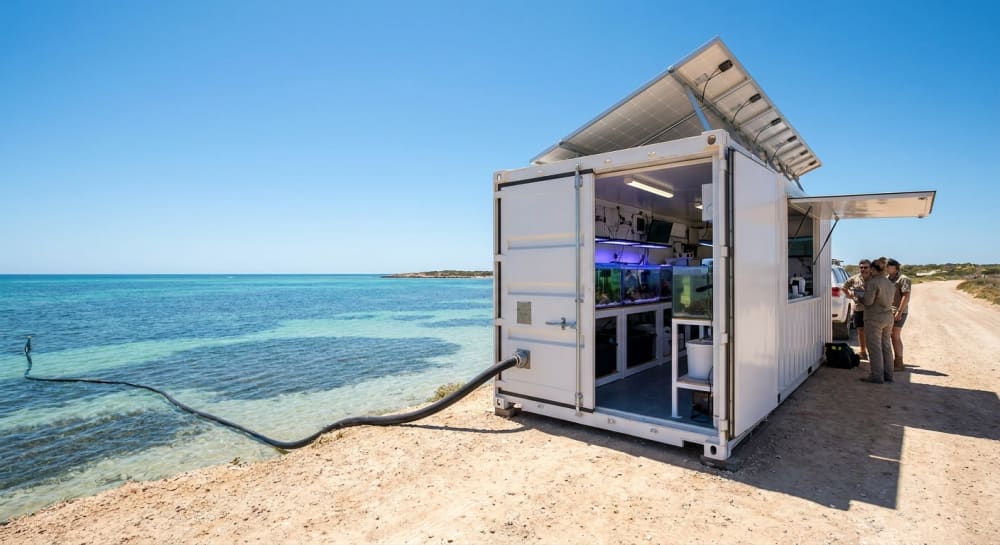
Florida Atlantic University’s Harbor Branch Oceanographic Institute, a premier marine research facility located on the Treasure Coast, has achieved a groundbreaking milestone in international marine conservation. In partnership with The Island School’s Cape Eleuthera Institute (CEI) in The Bahamas, Harbor Branch has announced that its innovative Queen Conch Mobile Lab is now fully operational following the first successful hatch of queen conch egg masses.
Supported by Chef José Andrés’ Longer Tables Fund, the mobile lab was established in February to aid the Cape Eleuthera Queen Conch Conservancy. The mobile facility is designed to cultivate up to 2,000 juvenile queen conch annually, directly supporting conservation and habitat restoration efforts across the Caribbean region.
In April, researchers at the facility introduced the initial egg masses, resulting in a successful hatch. This delicate early stage of the conch life cycle is critical for restoration efforts. According to researchers, approximately 200 newly metamorphosed conch have already been produced from the first egg mass. Furthermore, more than 100 additional individuals from a recent second egg mass have successfully completed metamorphosis, marking a crucial developmental transition from the free-swimming veliger stage to the benthic crawling juvenile stage.
Following the hatch, the larvae underwent a 21-day developmental cycle before initiating metamorphosis in response to seagrass detrital cues. These juveniles will now require approximately one year of growth before they are robust enough for release into wild seagrass habitats.
“We are incredibly excited to reach these milestones because it represents far more than the successful launch of a mobile hatchery,” said Megan Davis, Ph.D., director of FAU Harbor Branch’s Queen Conch Lab and a research professor of aquaculture and stock enhancement. “It demonstrates what is possible when science, conservation and community come together with a shared purpose. Seeing the first egg masses and hatch in the mobile lab means we are now actively growing the next generation of queen conch for restoration, for healthy seagrass ecosystems and for the communities across The Bahamas.”
Native to Florida and the Caribbean, the queen conch is vital for maintaining healthy seagrass beds by grazing on algae. However, the species has faced severe population declines due to habitat degradation and overfishing, leading to its listing as threatened under the Endangered Species Act. Surveys warn that commercial fishing in The Bahamas could become unsustainable within the next 10 to 15 years without immediate intervention. Because fewer than one percent of queen conch survive to adulthood in the wild, the mobile lab’s controlled environment provides a vital lifeline.
The lab itself is a 26-by-8-foot self-contained hatchery on wheels. Powered entirely by solar energy, the unit is equipped with specialized saltwater and aeration systems tailored for sensitive queen conch larvae and algae cultivation. By connecting to a local seawater source, the unit functions as a fully operational field hatchery in areas lacking permanent aquaculture infrastructure.
Beyond the scientific achievements, the Harbor Branch initiative places a heavy emphasis on local community engagement. The mobile lab is expected to draw up to 1,500 visitors annually, offering outreach programs, sustainable aquaculture education, and workforce training for local residents and fisherfolk.
This project in Eleuthera is part of a larger, long-term vision spearheaded by FAU Harbor Branch to establish community-based conch farms throughout the Caribbean. Since the launch of the first mobile hatchery in 2022, the Queen Conch Lab has expanded its conservation footprint to multiple locations, including:
- Puerto Rico
- Jamaica
- Curaçao
- Additional sites throughout The Bahamas
For their pioneering efforts in bringing restoration science directly to coastal communities, Harbor Branch’s Megan Davis and Assistant Director Becky Holt were recently honored with the 2025 Responsible Seafood Innovation Award in Aquaculture from the Global Seafood Alliance. Initial planning support for the project was provided by The Moore Bahamas Foundation.