

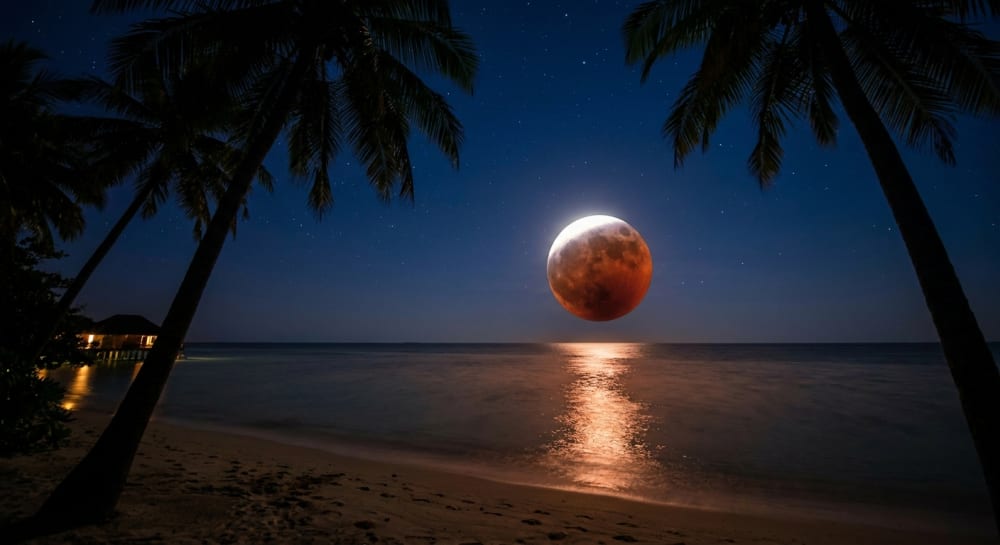
Vero Beach residents and Treasure Coast stargazers are in for a spectacular celestial treat this week. A near-total partial lunar eclipse is set to grace the Florida night skies, offering a stunning visual display that will temporarily transform the upcoming full moon into an “almost blood moon.”
Unlike solar eclipses, observers in Indian River County will not need to purchase special viewing glasses to safely enjoy this astronomical event. The eclipse coincides with the August full moon, traditionally known as the Sturgeon Moon. While Florida will not experience a total lunar eclipse, the Earth’s shadow will still put on an incredible show, covering nearly 94 percent of the lunar surface.
Vero Beach Viewing Timeline
For those planning to step outside and look up, the most dramatic phases of the eclipse will require staying up slightly past midnight. To catch the best moments in Vero Beach, here is the expected timeline for the start and peak of the celestial event:
- Penumbral eclipse begins: 9:23 p.m. on August 27
- Partial eclipse begins: 10:33 p.m. on August 27
- Maximum eclipse peak: 12:12 a.m. on August 28
What to Expect: An Almost Blood Moon
During the eclipse’s peak shortly after midnight, only a tiny sliver of the Sturgeon Moon will remain outside of the Earth’s darkest shadow. This massive coverage is expected to create a breathtaking optical effect in the night sky.
At maximum eclipse, about 93% of the moon’s diameter will be inside Earth’s dark central shadow, called the umbra. The moon will not be completely covered, but it can look dramatically darkened, with a rusty, coppery tint along the covered edge.
Because such a large portion of the moon is passing through the umbra, local viewers can expect a deep reddish-orange glow. According to NASA, this striking color occurs because the sunlight reaching the moon is filtered through a thick slice of Earth’s atmosphere. It essentially projects the light of all the world’s sunrises and sunsets directly onto the lunar surface.
Understanding Eclipse Seasons
This lunar event is part of a broader astronomical phenomenon known as an eclipse season. These seasons occur roughly twice a year and last between 31 to 37 days, representing the only periods when eclipses can happen. This specific window is driven by a perfect alignment of the Earth, moon, and sun in space—an alignment astronomers refer to as syzygy.
Solar and lunar eclipses often arrive in pairs during these seasons. The current alignment already brought a total solar eclipse to parts of the globe on August 12. For lunar enthusiasts, experts note that this late-August event will be the best lunar eclipse visible anywhere on Earth until New Year’s Eve in 2028. Since the 2028 eclipse will not be visible from Florida, this week’s event is truly a must-see for locals.
Tips for Local Stargazers
To get the best possible view of the Sturgeon Moon eclipse in Indian River County, observers should seek out locations away from bright streetlights and neighborhood glare. While the moon’s low position on the horizon might slightly obscure the earliest stages for some coastal residents, finding a dark, cloud-free spot—perhaps a quiet stretch of local beach or a clearing near the Indian River Lagoon—will provide a magnificent vantage point for the midnight peak.