

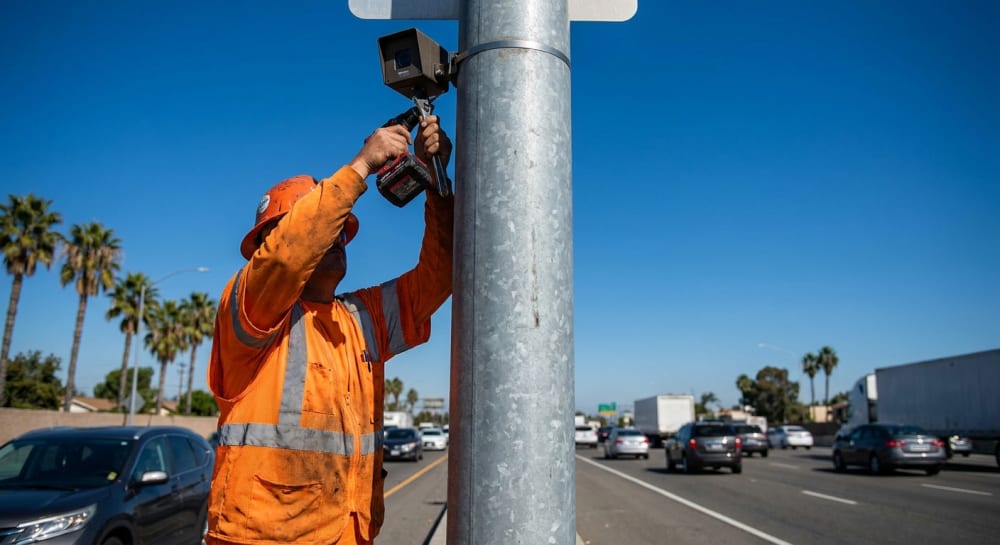
The Florida Department of Transportation (FDOT) has issued a sweeping statewide mandate requiring all local law enforcement agencies to remove automated license plate readers from state highway rights of way within 30 days. This sudden policy shift directly impacts Vero Beach, Sebastian, and the broader Indian River County area, where these surveillance devices have become a central tool in local policing.
Under a new Engineering and Operations memorandum signed by FDOT Chief Operating Officer Will Watts, all active permits for these devices on state property are immediately revoked. The department announced it will not issue new permits and reserves the right to dismantle any unit immediately if it poses a safety hazard. This administrative decision aligns with recent remarks by Governor Ron DeSantis, who expressed strong concerns about the rapid proliferation of these cameras, citing data privacy issues and warning against the creation of a surveillance state.
The Florida Department of Transportation has revoked all permits for automated license plate readers on state highways, forcing agencies in Indian River County to remove affected cameras by late September to address statewide privacy concerns.
For residents of Vero Beach and surrounding Treasure Coast communities, this mandate means a significant change in how local roadways are monitored. The order specifically targets state-operated thoroughfares, including:
- State Road 60 traversing through Vero Beach
- U.S. Highway 1 across Indian River County
- State Road A1A along the barrier island
- Interstate 95 corridors
The mandate does not apply to cameras positioned on locally governed city or county roads, private properties, or the mobile readers utilized by the Florida Highway Patrol.
Several local departments heavily rely on this technology, primarily utilizing the Flock Safety system. The Indian River County Sheriff’s Office officially operates over 100 of these fixed cameras, while monitoring dozens more. The Sebastian Police Department, Vero Beach Police Department, and Indian River Shores Police also maintain active units in strategic local spots, including Aviation Boulevard, Indian River Boulevard, and Jungle Trail. Any camera situated within an FDOT right-of-way must be taken down by late September.
Indian River County Sheriff Eric Flowers has been a staunch defender of the camera network, calling the technology a game-changer for solving violent crimes, locating missing persons, and recovering stolen vehicles. Recently, the system was instrumental in two major local cases. First, it helped authorities track a Vero Beach homicide suspect across state lines to West Virginia. Second, it played a critical role in solving a fatal August hit-and-run in Vero Beach, where a 48-year-old e-bike rider was struck near Eighth Street and 14th Avenue. Analysts used the cameras to identify a light-colored Ford F-150 missing a passenger-side mirror, leading to the vehicle’s location by the Florida Highway Patrol.
Sheriff Flowers emphasized that the technology is frequently utilized to exonerate innocent individuals, drawing a parallel between the public demand for police body cameras and the current debate over roadway surveillance.
The Flock Safety devices operate by capturing high-resolution photographs of passing vehicles. The system meticulously logs license plate numbers, vehicle colors, makes, models, direction of travel, and even specific identifiers like bumper stickers or dents into a searchable database. While critics argue that logging the movements of everyday citizens infringes on personal privacy, local law enforcement maintains that the system is an invaluable public safety tool. As the 30-day deadline approaches, Treasure Coast police departments must now audit their camera networks to comply with the state’s stringent new rules.