

Indian River County Commissioners have voted to temporarily hold off on a major land acquisition under the Environmental Lands Acquisition Panel (ELAP) program. In a 4-to-1 decision, the commission paused the signing of a $5.5 million contract for a 9.7-acre conservation parcel on the barrier island, seeking firm assurances that an environmental grant will reimburse the county for half the cost.
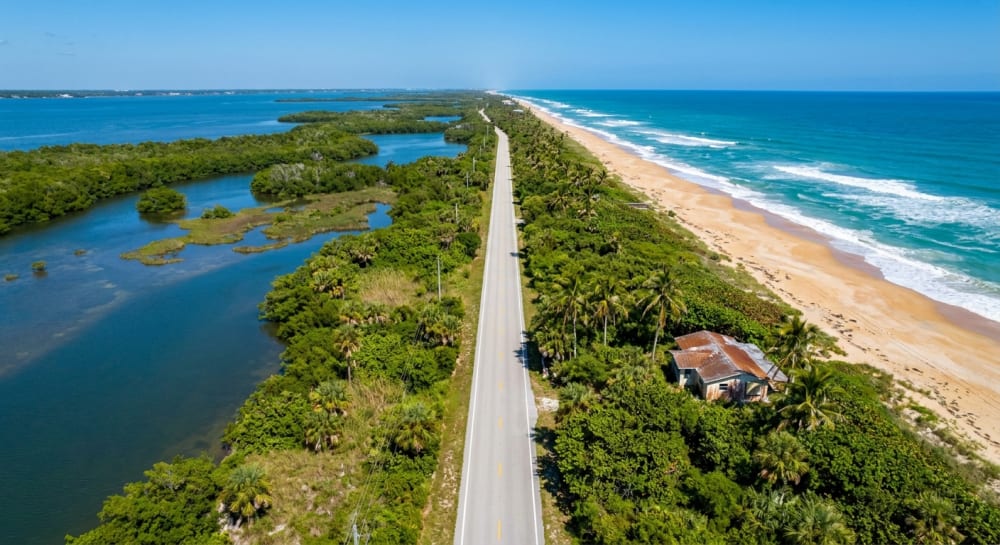
The proposed acquisition involves a low-lying parcel strategically positioned two miles south of the Sebastian Inlet and half a mile north of the Pelican Island National Wildlife Refuge. Lying within the boundaries of the Archie Carr National Wildlife Refuge, the property holds significant ecological value as a crucial habitat for nesting sea turtles. However, the price tag raised financial concerns among commissioners because roughly two-thirds of the parcel is submerged beneath the Indian River Lagoon west of A1A, while the remaining 2.3 acres consist of oceanfront land to the east.
Purchasing the land would permanently prevent private developers from building residences on the beach side or constructing a dock on the lagoon side. Yet, because the $5.5 million purchase price is higher than the average of its two independent appraisals—which came in at $5.58 million and $5.01 million—state law requires at least four of the five county commissioners to approve the deal.
“As much as I love ELAP, it’s a lot of money for submerged land. $5.5 million represents more than 10 percent of the entire $50 million that we have to spend.”
Commission Vice Chair Laura Moss highlighted the financial weight of the submerged property, a sentiment echoed by Commissioner Joe Flescher, who emphasized the need for prudent stewardship of taxpayer-approved bond funds. Conversely, Commissioner Joe Earman pointed out the land’s prime location in a top sea turtle nesting area, suggesting it could serve as an ideal spot for a future nature observatory.
The site also includes a dilapidated 1950s-era home. According to Wendy Swindell, the county’s assistant director for Parks & Conservation, the county might qualify for a FEMA Hazard Mitigation Grant to cover up to 75 percent of the demolition costs for the aging structure.
The county’s primary strategy for this acquisition is to secure a 50 percent matching grant from the Conservation Fund, which is currently applying for allocations from the U.S. Fish and Wildlife Service. This funding stems from the Natural Resource Damage Assessment and Restoration Fund, established by the settlement from the 2010 Deepwater Horizon oil spill. To allow time to confirm the status of this grant, the commission directed Assistant County Attorney Chris Hicks to request a six-month extension on the letter of intent from the property owner, the W. David Crosby Revocable Trust.
While the barrier island parcel is on hold, commissioners successfully advanced another local conservation initiative. They finalized a $1.57 million contract for 36 acres on the western shore of the Indian River Lagoon near Wabasso after resolving previous title issues.
The county’s environmental purchasing power is fueled by a $50 million bond approved by voters in 2022. The first $25 million phase, issued in June 2024, must be utilized by June 2027. To date, Indian River County has successfully closed on three significant parcels to protect local ecosystems:
- Hale Groves Site: 21.89 acres on U.S. 1, situated a mile north of the Wabasso Causeway, purchased for $2.54 million.
- Durrance Place: 11.72 acres adjoining the Hale Groves property east of U.S. 1, acquired for $1.26 million.
- Osprey Estates: 15.47 acres situated west of the Indian River Lagoon across from Gifford Point, secured for $1.64 million.
With the newly approved 36-acre Wabasso tract and an additional 19.39-acre parcel next to the Captain Forster Hammock Preserve currently under contract, Indian River County continues to prioritize preserving the region’s irreplaceable natural habitats for future generations.