
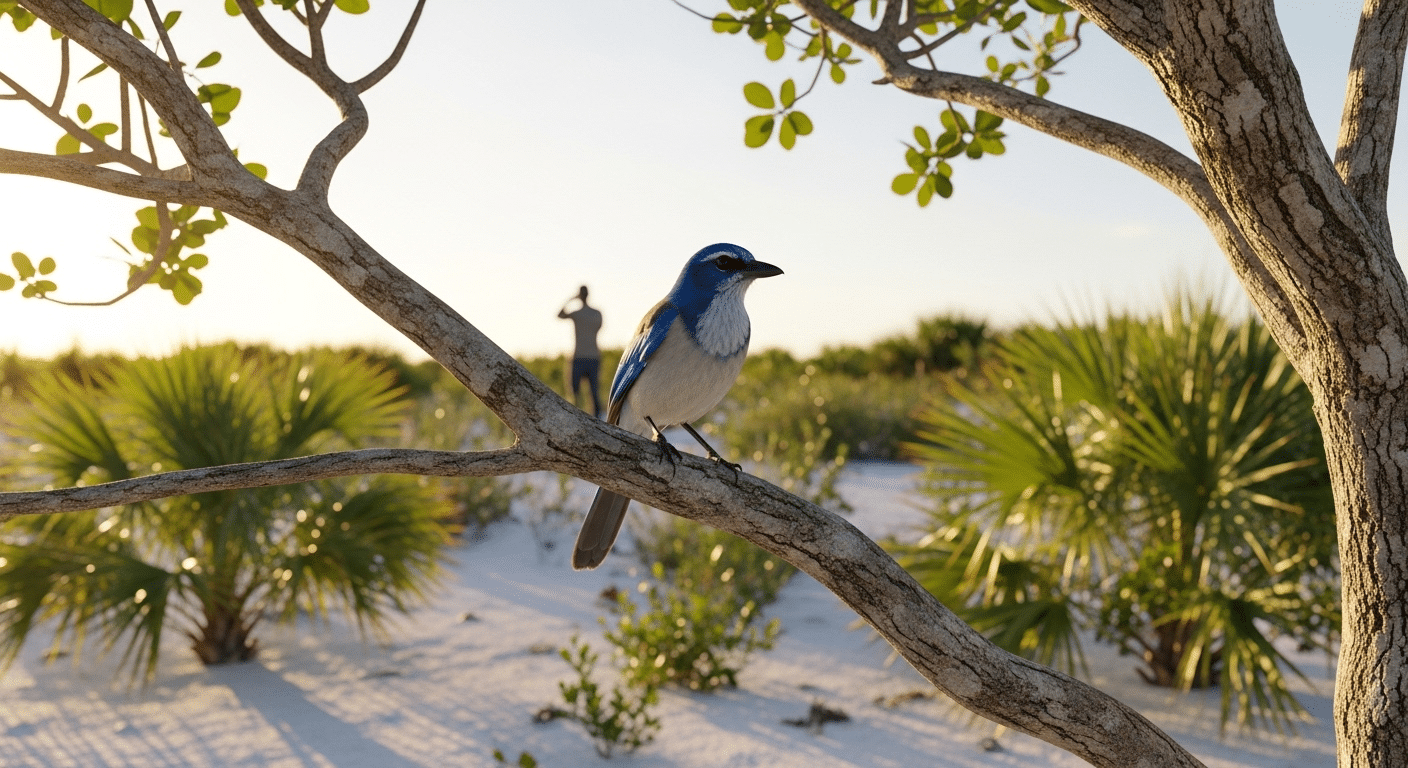
Indian River County’s commitment to environmental preservation has garnered national attention, as Beth Powell, the county’s esteemed Director of Parks, Recreation and Conservation, was recently honored for her quarter-century of dedicated conservation work. Powell received a prestigious fully paid scholarship to the 2025 National Habitat Conservation Planning Conference, held in Shepherdstown, West Virginia, a testament to her leadership in safeguarding the threatened Florida Scrub-jay habitat across Vero Beach and the wider Indian River County area.
The accolade comes in the form of the inaugural John Hopkins scholarship, named after the founder of the National Habitat Planning Coalition, which hosted the significant event. Powell not only absorbed insights from fellow conservation professionals nationwide but also presented on her groundbreaking work managing the county’s Sebastian Area-wide Florida Scrub-jay Habitat Conservation Plan (HCP). This visionary plan, adopted in 2000, stands as one of the very first of its kind in Florida, setting a precedent for effective environmental stewardship.
The Florida Scrub-jay, a protected threatened species under the Federal Endangered Species Act, faced a dire situation in the Sebastian area between 1991 and 1998, with its population plummeting by 45%—from 35 breeding pairs to a mere 16. The primary culprits were habitat loss due to unchecked development and fragmentation caused by fire suppression, which prevents the natural clearing essential for the scrub habitat these unique birds call home. Scrub-jays thrive in areas of shorter, immature trees and shrubs, such as prickly pear, hog plum, gopher apple, and various oak species, which protect them from predators like hawks and snakes.
“We have the most amazing HCP,” Powell remarked, reflecting on the foresight of its creators. “The people who wrote it had a vision of what could happen in the future in this urban area.”
Thanks to Powell’s diligent management, mapping, banding, and monitoring efforts since 2000, the Scrub-jay population has seen a remarkable resurgence. From approximately 10 family groups when she began, Indian River County now boasts an impressive 110 family groups, each comprising two to six birds. Her department diligently manages five critical conservation areas vital for these birds:
- North Sebastian Scrub Conservation Area, spanning 406 acres.
- Sebastian Highlands Conservation Area, a 10-acre sanctuary.
- Wabasso Scrub Preservation Area, encompassing 111 acres.
- Pelican Island Elementary School Scrub-jay Preserve, a 12-acre haven.
- Sebastian Airport Scrub Conservation Area, covering 30 acres.
All but the Airport Conservation Area are open to the public, allowing residents and visitors to appreciate the success of these initiatives firsthand. A crucial aspect of the HCP was the establishment of a migratory corridor to the 22,000-acre St. Sebastian River Preserve State Park, facilitating the movement of around 55 families and significantly enhancing the species’ genetic diversity, making them more resilient to disease.
The HCP also incorporates Incidental Take Permits (ITPs), allowing for mitigated development by requiring developers to contribute to conservation efforts elsewhere. Powell proudly noted the mitigation of 14,000 lots in the Sebastian Highlands area under their ITP, stating, “This is literally what sustainable development looks like.” Public support for such initiatives is robust, as evidenced by resident feedback during the county’s Parks and Recreation Master Plan formulation.
While celebrating these achievements, Powell acknowledged ongoing challenges. The county’s voter-approved $50 million Environmental Lands Program continues to acquire new conservation lands, necessitating additional staff beyond the current five dedicated conservationists from her team of 165. Furthermore, potential staff reductions at the U.S. Department of Interior (DOI) could hinder collaboration essential for maintaining compliance with the Endangered Species Act. Despite these hurdles, Indian River County remains a beacon of environmental responsibility and community pride in its commitment to protecting its unique natural heritage.