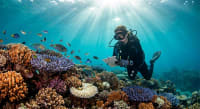

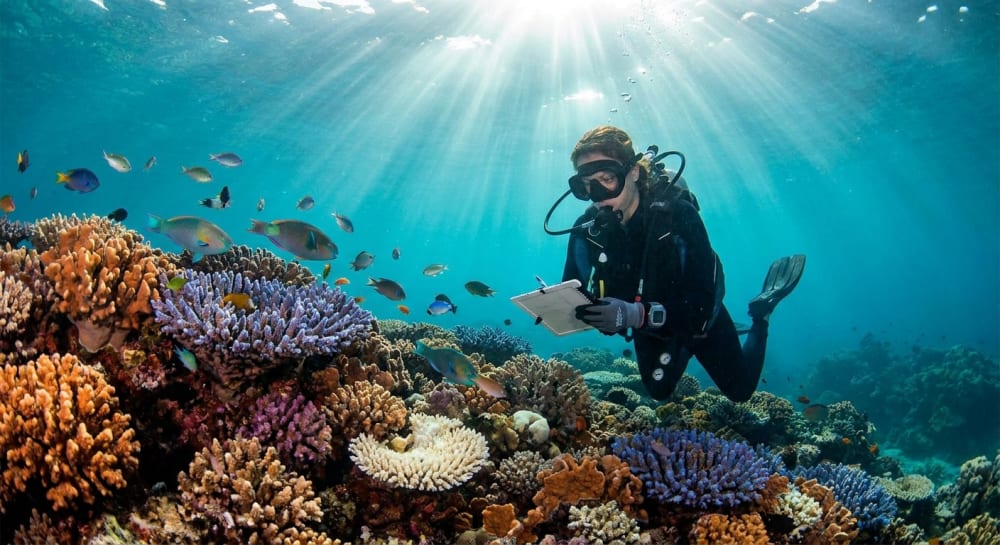
Researchers at the Treasure Coast’s own Florida Atlantic University Harbor Branch Oceanographic Institute have made a significant breakthrough in understanding how coral reefs might survive rapidly warming ocean temperatures. In collaboration with the University of Hawaiʻi, local marine scientists investigated how different coral species respond to heat stress, offering vital insights that will shape future global marine conservation efforts.
The study, recently published in the journal Scientific Reports, focused on two common reef-building corals: Montipora capitata (rice coral) and Porites compressa (finger coral). To understand the impact of environmental history on thermal tolerance, the researchers collected coral fragments from two contrasting neighboring bays in Oʻahu—the warmer, sheltered Kāneʻohe Bay and the cooler, more exposed Kailua Bay, specifically the Ulupaʻu area.
The research demonstrated that a coral’s ability to withstand extreme heat stress is heavily influenced not only by its species identity but also by its local environmental history, providing crucial guidance for identifying naturally heat-tolerant corals for global reef restoration.
Using laboratory-controlled thermal stress experiments and Pulse Amplitude Modulation fluorometry, the Harbor Branch scientific team measured the photosynthetic efficiency of the corals to assess their physiological responses to warming waters. The exhaustive study uncovered several critical insights into marine resilience:
- Both coral species exhibited substantial baseline thermal tolerance, surviving well above the standard heat stress indicators typically associated with the onset of significant coral bleaching.
- Porites compressa sourced from the cooler, wave-exposed Ulupaʻu waters demonstrated significantly higher thermal tolerance than the exact same species taken from the warmer, sheltered Kāneʻohe Bay.
- Within the cooler environment, Porites compressa tolerated considerably more accumulated heat stress than Montipora capitata and bleached at a noticeably slower rate.
Joshua D. Voss, Ph.D., senior author and research professor at FAU Harbor Branch, emphasized that coral resilience is far from uniform, even among species living in close geographic proximity. As marine heat waves become more frequent and intense, pinpointing which corals can best tolerate thermal stress—and understanding the environmental factors that prepare them for it—is paramount to protecting and restoring reefs. The data suggests that a cooler, more variable, and wave-exposed environment might actually prime certain coral populations to better withstand sudden spikes in ocean temperatures.
Allison M. Klein, Ph.D., the study’s first author and a postdoctoral fellow at the local Fort Pierce institute, highlighted that their specialized approach allowed for direct comparisons across different populations. By standardizing the thermal stress testing, the team could isolate how prior environmental conditions actively shape a coral’s physiological defenses.
While discovering naturally heat-tolerant corals offers an exciting avenue for reef restoration, the Treasure Coast researchers provided an important caution. Conservationists should not assume that the most heat-tolerant corals are universally the best candidates for every restoration project. Maintaining wide genetic diversity and a broad range of biological traits remains essential to giving restored reefs the flexibility they need to adapt to unpredictable, shifting environmental conditions over time.